


1.0 Introduction: Re-evaluating Christian Origins
The conventional narrative of Christianity’s origin presents it as a unique, divinely ordained historical event that erupted with revolutionary force into a world of spiritual darkness. This long-held view collapses under a forensic examination of pre-Christian traditions, which reveals a far more complex and ancient lineage. This paper advances the central thesis that the core tenets, figures, and doctrines of both Gnostic and historic Christianity are not original revelations but are, in fact, direct derivations from pre-existing Egyptian mythology and typology. The foundational elements of the Christian faith, from its ethical precepts to its central savior figure, were extant long before the Christian era, rooted firmly in the soil of the Nile Valley.
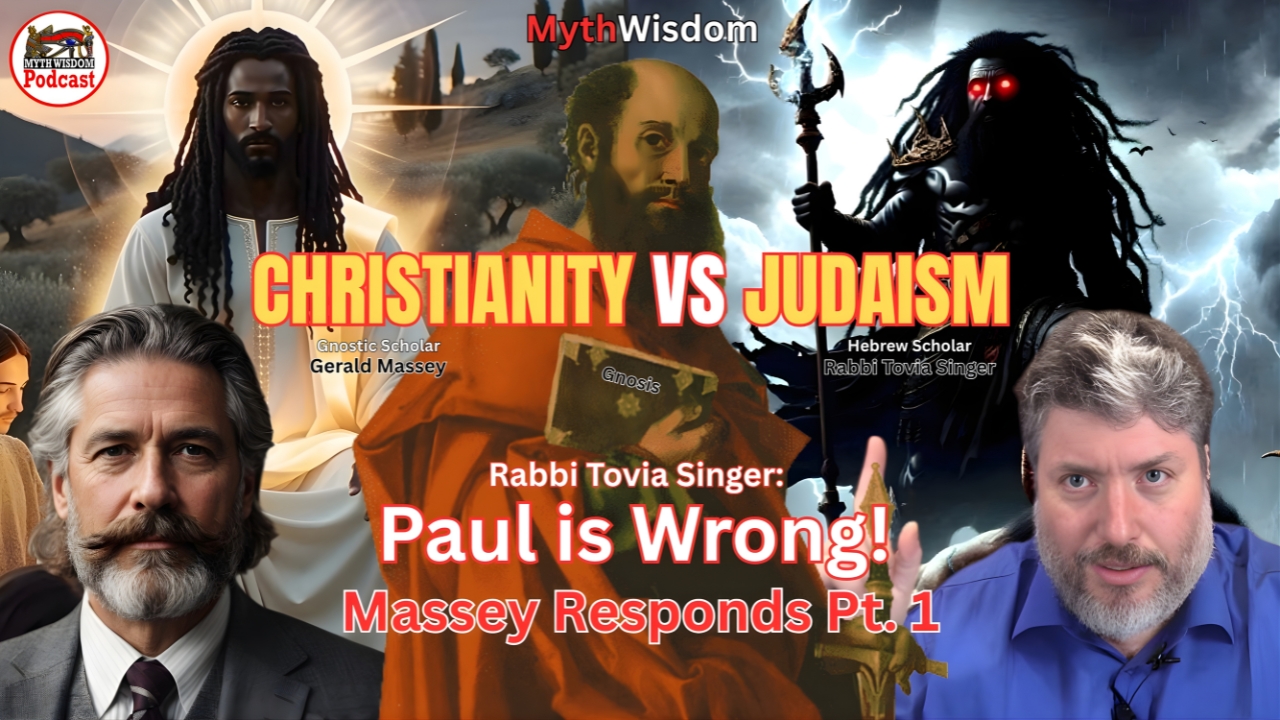
The primary argument of this paper aligns with the contention of comparative mythologist Gerald Massey, who asserted that “the original mythos and gnosis of Christianity were primarily derived from Egypt on various lines of descent.” To substantiate this claim, this paper will examine several key lines of evidence. First, it will establish the pre-Christian existence of communities such as the Essenes, who practiced a system of ethics and communal living later attributed to Jesus and his disciples. Second, it will explore the fundamental conflict between the Gnostic (mythical) Christ and the later, historicized (carnalized) Christ, demonstrating that the former was the original spiritual type. Finally, it will trace the direct conceptual and etymological lineage of core Christian doctrines, most notably the concept of the “Word of Truth,” from its Egyptian source as Ma-Kheru to its appearance in the earliest Christian epistles.
Ultimately, this analysis will demonstrate that the historical Christian narrative was meticulously manufactured by adapting, literalizing, and thereby carnalizing this ancient Egyptian Mythos. This process of conversion obscured Christianity’s own origins, creating what Massey termed a “vast falsehood” that has persisted for centuries. By excavating these foundational layers, we can begin to reconstruct a more accurate genesis of Christian belief, one that acknowledges its deep and undeniable debt to the ancient wisdom of Egypt.
——————————————————————————–
2.0 The Primacy of the Mythos: From Egyptian Allegory to Christian History
To correctly interpret Christian origins, it is of strategic importance to understand the distinction between the original Mythos—a sophisticated system of allegorical representation—and the later, manufactured History. The Mythos was a symbolic language used in the ancient mysteries to convey natural, astronomical, and spiritual truths through typology and personification. Historic Christianity, in its effort to establish a unique and earthly foundation, inverted this ancient order, mistaking the allegorical figures for historical personages and the symbolic narratives for records of actual events.
This process involved a deliberate reversal of what was first in time and originality. The ancient Gnostic and Egyptian wisdom that preceded the Christian era was recast as a later heresy, while the manufactured history was presented as the primordial truth. Massey illustrates this inversion with a striking metaphor: “All that was first in time and in originality has been put latest, in order that the prophecy might be fulfilled… it were like that representation in the German play where Adam is seen crossing the stage in the act of going to be created!” By this method, the allegorical Christ of the Gnosis was made to follow its own earthly and historical reflection, making the substance appear to be born from its shadow.
This manufactured history was accompanied by a powerful but fallacious narrative of its own inception. Conventional accounts depict the dawn of Christianity as a sudden “great light” illuminating a world steeped in profound darkness. This imagery, while poetically potent, is historically inaccurate. A more fitting analogy, proposed by Massey, is that of the Nile’s sources. The great river does not spring from a single, isolated fountainhead but arises from a “vast concourse of many tributary springs.” So too did Christianity emerge not from a single founder in Judea, but from a confluence of pre-existing traditions, with its most significant and life-giving tributaries flowing directly from Egypt.
In this context, the role of the Roman Church must be re-evaluated. Far from being a “crucible for purging the truth from the dross of error,” it functioned as a “melting-pot, in which the beautiful and noble mental coinage of Greece and Egypt was fused down and made featureless, to be run into another mould,” stamped with a newer name, and reissued under a later date. To understand the original substance before it was melted down, we must turn to the pre-Christian communities that embodied its principles.
——————————————————————————–
3.0 The Pre-Historic Christians: The Essenic and Gnostic Foundations
Long before the era named for Christ, communities that can be rightly described as “prehistoric Christian” were well-established, practicing the core ethics and communalism later canonized in the Gospels. Groups such as the Essenes, Nazarenes, and Therapeutae embodied the spiritual and social ideals of what would become Christianity, demonstrating that the faith existed in practice before its purported historical founder appeared. These brotherhoods were not a new revelation but the continuation of a spiritual tradition with deep roots in Egypt.
The Egyptian origin of these communities is evident in their very names and locations. The names Essene and Therapeutae are synonymous, both meaning “Healers.” This title can be traced directly to the old Egyptian word Usha, meaning “to doctor,” which identifies the Ushai, or Essenes, as healers by name. This connection is not merely etymological but geographical. The ancient accounts of Philo and Pliny place these communities near Lake Mareotis in Egypt, attesting to their long-standing presence in the region for “ages on ages” before the first century.
The ethical system of the Essenes, as documented by the historian Philo-Judæus, presents a perfect model of what would later be termed an “Ideal Christian Community.” Their entire way of life was governed by three core principles:
• Love to God: Evidenced by a life of matchless sanctity, a profound fear of oaths and lies, and the conviction that God is the originator of good only, never of evil.
• Love of Virtue: Demonstrated through their indifference to material gain, glory, or pleasure; their commitment to temperance, simplicity, and humility; and their steadfast faithfulness.
• Love for Man: Exemplified by their profound kindness, absence of pretension, and, most notably, their practice of holding all goods in common, ensuring mutual support for all members of the community.
When contrasted with this pre-existing reality, the “new” commandments attributed to Jesus in the Gospels are revealed to be not new at all. The precepts to “carry neither purse, nor scrip, nor shoes,” and the “new commandment” to “love one another,” were not novel revelations but were simply verbalizations of what the Essenes had “always done.” Their greeting and password was “Peace be with you!”—the same used by the resurrected Christ. Moreover, before any disciple could have gone forth to preach, a widespread secret organization of “the Worthy” was ready to receive them. These were not new converts but pre-existing Essenic initiates, bound by their ancient rules to succor their brethren.
Furthermore, a fundamental theological incompatibility existed between these early Gnostic communities and the historic Christianity that would supplant them. This chasm highlights the profound transformation—and corruption—of the original doctrine:
• As “phenomenal Spiritualists,” the Essenes and Gnostics possessed direct, inner knowledge of spiritual continuity. For them, the physical resurrection of the body was a fundamental fallacy upon which no Gnostic could ever build their faith.
• They repudiated all forms of blood-sacrifice, whether animal or human, upholding only the sacrifice of the self. The later doctrine of salvation through the bloody sacrifice of an incarnate son of God was antithetical to their beliefs.
• They rejected other key practices and texts of the later faith, including anointing with oil (which they considered a defilement) and the authority of the Pentateuch, which formed the prophetic groundwork for the historicized redemption story.
These pre-historic Christians were the keepers of an ancient Gnosis, an inner knowledge founded on a spiritual and mythical Christ. This exposes the deep theological chasm separating the original Gnostic understanding from the later, carnalized conception of Christ.
——————————————————————————–
4.0 The “Word of Truth”: Tracing the Ma-Kheru from Egypt to the Epistles
The critical link proving a direct doctrinal lineage from Egyptian theology to the earliest Christian teachings is found in the concept of Ma-Kheru. This Egyptian term, meaning the “Word of Truth,” was not merely a title but the central pillar of a salvation doctrine based on an internal, spiritual principle. Long before the “Word was made flesh” in the Gospel of John, it existed as the Ma-Kheru in Egyptian Mythos and was transmitted directly into the non-historical epistles of the nascent Christian Gnostics.
To understand this concept, one must first grasp the dual nature of the Egyptian savior figure, Horus. First, as the silent, inarticulate child of the virgin, he is the “Imperfect Word.” Only upon reaching virile adulthood does he become Har-Makheru, the “Word made Truth,” capable of vanquishing darkness. This title is a direct compound of Ma (Truth) and Kheru (the Word).
In Egyptian theology, the Ma-Kheru is the divine agency through which cosmic and spiritual order is achieved. It is the “Word of Truth” that vanquishes the enemies of the light, gives life to humanity, and empowers individuals to conquer their own sins. This was not an external force but an internal principle conferred by the deity. The faithful who were saved by this principle were known in the Egyptian texts as the Makheru—the Justified—a state of spiritual salvation achieved thousands of years before the Christian era.
The direct continuation of this purely Gnostic and Egyptian doctrine is found with stunning clarity in the Epistle of James, a text that Massey argues is pre-historic Christian precisely because it lacks any trace of a historical savior. James’s entire soteriology is built upon the Ma-Kheru:
“Of his own will begat he us with the ‘Word of Truth’.”
He further instructs his followers to receive “the implanted Word which is able to save your souls.” This teaching is fundamentally Gnostic, Essenic, and Egyptian. Salvation comes directly from the “Father of Lights” through an indwelling principle—the Christ within. It requires no historical intermediary, no physical death or resurrection. The phrase “Word of Truth” is a direct and perfect translation of the Egyptian Ma-Kheru.
This same doctrine is echoed powerfully in the writings of Paul, who speaks of the “Word of Truth” and argues that salvation does not need to be “brought down from heaven” for an incarnation or “brought up from the dead” by a resurrection. Why? Because, as he states, quoting the ancient wisdom, “that Word is in thy heart that thou mayest do it!” Paul further identifies the Ma-Kheru when he exhorts Timothy to “hold a straight course” according to the “Word of Truth,” a direct reference to the Egyptian root Ma, which means “to hold out straight before one.”
The transformation of this concept reveals the very process by which history was fabricated. The “Word of Truth” which is purely doctrinal and internal in the epistles of James and Paul is later made literal and external in the Gospel of John, where it becomes the “Word of Truth made flesh.” This doctrinal lineage, tracing the Ma-Kheru from the Egyptian Mythos directly into the earliest Christian scriptures, fatally undermines the claim that Christianity began with a new, historical revelation.
——————————————————————————–
5.0 The Fabrication of History: Deconstructing the Canonical Gospels
The conversion of the Gnostic, non-historical Mythos into a human history was not a gradual evolution of belief but a deliberate act of fabrication. This was achieved by systematically altering earlier Gnostic gospels, inserting fabricated historical details, and grounding the mystical Christ in a mundane, earthly narrative. The forgers took the spiritual allegory and clothed it in the flesh of a manufactured biography, thereby creating the foundations for historic Christianity.
A crucial piece of evidence for this process is the “Gospel of the Lord,” an early Gnostic text attributed to Marcion, which served as the precursor to the canonical Gospel of Luke. The Christ of Marcion’s gospel is an entirely mythical and non-historical being. As Massey describes, Marcion’s Christ:
“has no genealogy or Jewish line of descent; no earthly mother, no father, no mundane birthplace or human birth.”
This Christ is a “phantom” who does not undergo a human life cycle but appears suddenly on the world stage as a full-grown man. This was the Gnostic Christ—a spiritual type, not a historical person. By comparing this earlier text with the canonical Luke, we can witness the forgers at work, adding the very details necessary to create a human story.
The specific additions and alterations made by the author of Luke to Marcion’s Gnostic text represent a clear pattern of historical forgery. These manufactured facts were inserted to provide an earthly foundation for what was originally a celestial allegory:
• Parentage: The question designed to establish a human father, “Is not this Joseph’s son?” was added by the author of Luke and does not appear in Marcion’s gospel.
• Family: The scene in which “his mother and brethren” came to see him, a key detail for establishing a human family, was also an addition by Luke.
• Prophetic Fulfillment: The statement that “all things that are written by the prophets shall be accomplished by the Son of Man” was inserted. This method of manufacturing history by claiming fulfillment of Hebrew prophecy was not used in the original Gnostic gospel.
• The Mount of Transfiguration: To create a specific historical nexus, Luke’s author added the detail that “Moses and Elijah… spake of his decease which he was about to accomplish at Jerusalem.” This passage is absent from the “Gospel of the Lord.”
• The Triumphal Entry: The story of the colt and the riding into Jerusalem in triumph are additions to the earlier Gospel.
• The Last Supper: Crucial elements of the passion narrative were fabricated and inserted. Twelve verses of Luke 22 are missing from Marcion’s text, including the distribution of the Paschal cup and the promise made to the thief on the cross.
These additions were not minor theological adjustments; they represent, in Massey’s words, the “very forgery of the human foundations and the insertion of the manufactured facts” upon which historic Christianity was built. The canonical gospels are a “Palimpsest,” a document where the original writing has been scraped away and overwritten. By holding the document up to the light, “the watermark of the Egyptian mythos” becomes undeniably clear. This demonstrable evidence of deliberate fabrication provides the final proof that the historical narrative of Christianity was not a record of events, but a conscious and methodical invention.
——————————————————————————–
6.0 Conclusion: The Enduring Mythos
This examination has traced the origins of Christianity not to the hills of first-century Judea, but to the ancient mythological and typological systems of Egypt. The evidence demonstrates that the core elements of the Christian faith—its ethical framework, its central doctrines, and its savior figure—were not new revelations but continuations of a pre-existing Gnostic tradition rooted in Egyptian wisdom. By reversing the established narrative, we find that the Mythos was primordial and the history was a later, and deliberate, fabrication.
The key lines of evidence presented in this paper form a cumulative and compelling case. The pre-existence of Essenic and other Gnostic communities, which practiced “Christian” ethics and communalism long before the Christian era, proves that the social ideals of the faith were not original. The direct doctrinal lineage of the “Word of Truth” from the Egyptian Ma-Kheru to the Epistles of James and Paul shows that the plan of salvation through an internal, spiritual Christ was central to the earliest believers, leaving no room for a historical redeemer. Finally, the demonstrable fabrication of historical details in the canonical gospels, when compared to earlier Gnostic texts like Marcion’s, reveals the methodical process by which a mythical allegory was converted into a human biography.
This body of evidence leads to Gerald Massey’s powerful and concise assessment of historic Christianity: “what is true in it was not new, and that which was new in it is not true.” The timeless spiritual truths it contains were inherited from the Gnostic Mythos, while the historical claims upon which it built its unique identity are false.
In the final analysis, the supposed human history of Jesus is revealed to be the “mundane shadow of the Gnostic Christ.” An ancient and profound allegory, rich with astronomical and spiritual meaning, was misinterpreted, carnalized, and sold to the world as literal fact. This conversion of myth into history was not merely a misunderstanding but an “irretrievable error committed in the name of Historic Christianity,” the consequences of which have obscured the true origins of the faith and severed its connection to the ancient wisdom from which it was born.



Leave a Reply