


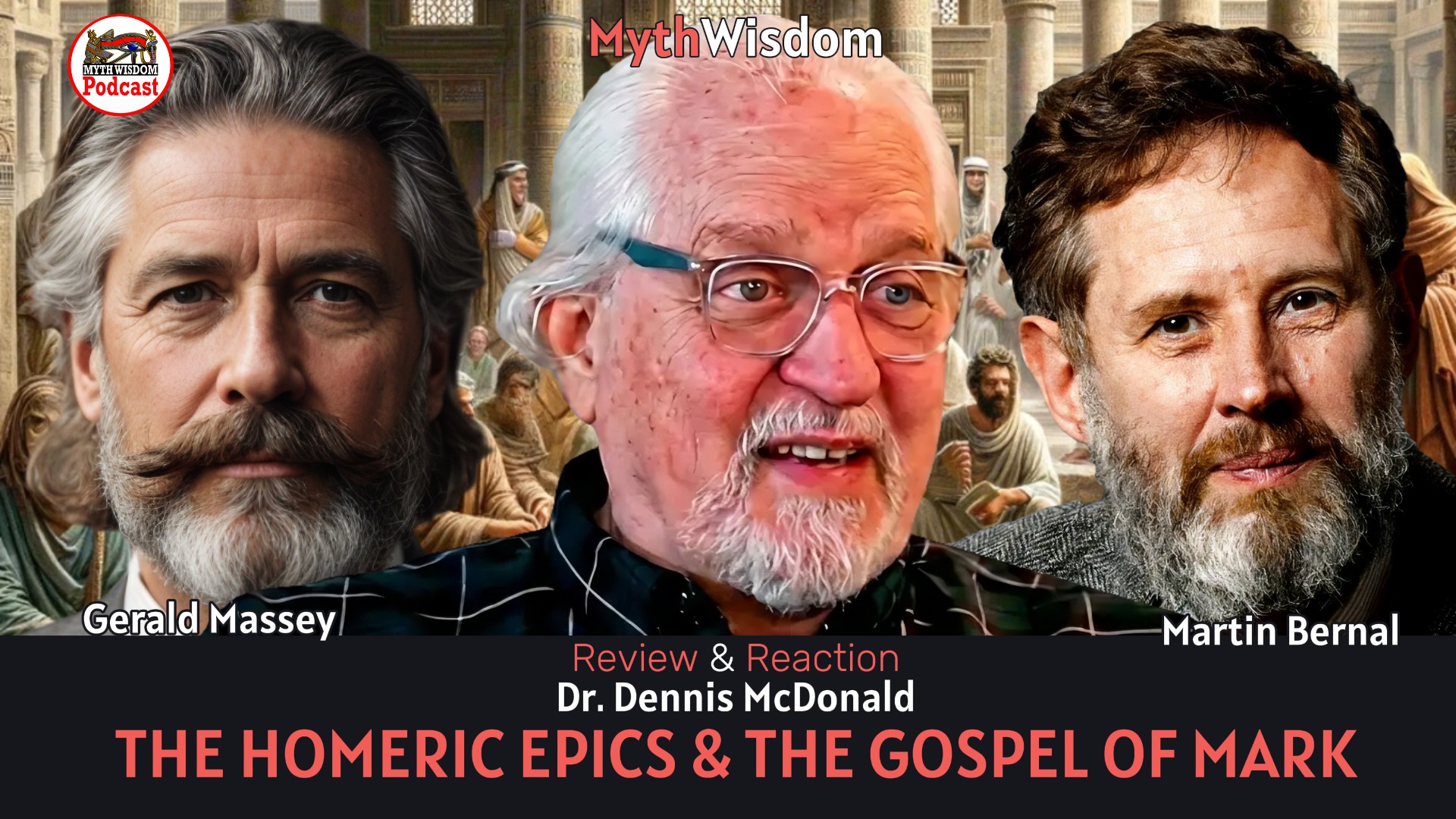

Introduction: Framing MacDonald with Massey and Bernal
Dennis R. MacDonald’s thesis in The Homeric Epics and the Gospel of Mark posits that the author of Mark’s Gospel was not writing a historical record, but rather a deliberate “prose anti-epic” through the process of mimesis, or literary imitation. MacDonald argues that Jesus was intentionally modeled after Homeric heroes—primarily Odysseus, but also Hector and Achilles—to demonstrate his superiority over pagan ideals. To evaluate the rigor of this claim, we must employ the Egyptocentric diffusionism of Gerald Massey and the Afro-Asiatic model of Martin Bernal. Massey asserts that the Christian mythos is a “resurrection pie” of Egyptian origins, with the Gospel narratives representing literalized versions of the mysteries of Amenta. Meanwhile, Bernal’s “Revised Ancient Model” contends that the Greek culture MacDonald identifies as Mark’s primary source was itself a product of massive Egyptian and Semitic colonization and cultural influence. Together, these frameworks interrogate whether MacDonald’s Greek literary horizon is a primordial reality or merely a secondary “melting-pot” that obscures older African and Levantine substrates.
MacDonald’s Thesis and Argumentative Architecture
MacDonald constructs his case around the ancient educational practice of mimesis, where students learned to write by refashioning Homeric models. He identifies “transvaluation” as Mark’s core strategy: a process of competitive emulation (aemulatio) that substitutes Christian values for the pagan values found in the Iliad and Odyssey. MacDonald’s architecture relies on seven criteria to judge dependency: accessibility, analogy, density, order, distinctive traits, interpretability, and ancient recognition.
The Gospel’s plot follows a “long absent king” (Jesus as the Son of God) whose inheritance is usurped by evil rulers (the Jewish authorities) and who must endure supernatural trials, many sea adventures, and a descent into the grave before reclaiming his kingdom. Specific parallels include Jesus calming the sea as a superior version of Aeolus, sending demons into swine as a transvaluation of Circe’s magic, and the burial of Jesus by Joseph of Arimathea as a structural imitation of Priam retrieving Hector’s body. MacDonald concludes that Mark is a work of “theological fiction” that retools Greek epics into a new myth for a humble, prose-reading audience.
Dialogues with Gerald Massey
When viewed through Massey’s Egyptocentric lens, MacDonald’s Homeric parallels appear as secondary adaptations of primordial Egyptian motifs. MacDonald links Jesus’ sea-based ministry to the Odyssey, yet Massey identifies the “water-walker” as a type of the sun-god Horus or the manes in Amenta traversing the celestial lake. The “miraculous” calming of the storm, which MacDonald sees as an imitation of Aeolus, corresponds to the 108th chapter of the Ritual, where Ra (the sun-god) stays the tempest during the attack of the Apophis-serpent.
Further, MacDonald’s “enigmatic” reference to the young man fleeing naked at Jesus’ arrest is tied to Elpenor’s death in the Odyssey. However, Massey provides a more fundamental eschatological root: the “young man” is a form of the manes risen from the mummy-swathes, having “left the linen-cloth” to make a transformation into spirit. While MacDonald sees the feeding of the multitudes as a transvaluation of Homeric feasts, Massey points to the Egyptian “place of multiplying bread” (Annu), where the manes are fed on seven loaves of celestial diet. Consequently, Massey would argue that MacDonald’s “Homeric mimesis” is actually the final stage of a long “literalization” where the Egyptian mythos of the afterlife was converted into a human history, using Greek epic forms as a stylistic bridge.
Dialogues with Martin Bernal
Applying Bernal’s critique of the “Aryan Model” reveals that MacDonald may be naturalizing a Eurocentric literary environment that erases Afro-Asiatic priority. Bernal argues that up to 90 percent of Greek divine and mythological names are of African or Semitic origin. MacDonald identifies Jesus as a “new Odysseus,” but fails to theorize that the character of Odysseus may himself be a Mediterranean hybrid influenced by the Mesopotamian Gilgamesh or Egyptian sailor-tales.
MacDonald’s emphasis on Mark’s Greek literacy as the driver of mimesis overlooks the fact that Greek “originality” often consisted of “reworking concepts received from others” in the Near East. Bernal’s linguistic analysis suggests that “central abstract words” MacDonald attributes to Greek thought, such as time (honor) and kudos (sacred glory), have plausible etymologies in Egyptian d(t) m-at and Semitic qds. By centering Homer as the primary “hypotext,” MacDonald unintentionally reinforces a model that decouples Greece from its Egyptian and Levantine foundations. Bernal would insist that the Homeric “flags” MacDonald detects are actually markers of a broader Mediterranean “koinē” that was already saturated with Afro-Asiatic religion and law before Mark ever sat down to write.
Critical Evaluation and Synthetic Judgment
Dennis R. MacDonald’s contribution to Gospel studies is profound in its ability to decenter naive historicism and foreground the literary patterning of the early Church. However, when tested against the criteria of Massey and Bernal, his model is revealed as culturally restricted. MacDonald’s “environmental” criteria of accessibility and analogy effectively prove that Mark was literate in Greek, but they ignore the deeper “environmental” reality that the Greek literary tradition was a colonial offshoot of older civilizations.
The primary strength of MacDonald’s work is its exposure of Markan “history” as theological fiction. Its primary weakness is the neglect of the “primal source” of the Nile Valley and the Levant. To be truly rigorous, MacDonald’s model must be expanded to include “double-mimesis”: Mark may indeed have imitated Homer, but he was simultaneously refashioning a Greek tradition that was already a hypertext of Egyptian and Semitic myths. Ultimately, MacDonald’s work supports projects locating Christian origins within a broader religious genealogy, but his framework requires an Afro-Asiatic revision to account for the untheorized substrates that underpin both the Homeric epics and the Gospel of Mark.



Leave a Reply