


This comprehensive exposition analyzes the Egyptian foundations of Gnostic thought, the evolution of the Messianic mythos, and the role of Paul as a Gnostic initiate using the systematic comparative typology established by Gerald Massey.
I. Foundations: Massey, Egypt, and Gnosis
Gerald Massey’s core thesis maintains that the entire structure of Christian theology is an Egyptian mythos converted into a human history. His methodology relies upon comparative typology and astronomical mythography to demonstrate that the “historical” events of the New Testament were pre-extant as celestial allegories in the Egyptian Ritual (the Book of the Dead). Massey argues that the “one God” of later monotheism was not a primary intuition but a final result of the evolution of nature powers, starting with the Great Mother and the seven elementaries. These mythical types—the Virgin Mother, the ever-coming Son, and the crucified-and-risen Lord—were formulated over 10,000 years of Nilotic observation before being “carnalized” by the “A-Gnostics” or “Sarcolatrae” (flesh-worshippers) who mistook mystery dramas for mundane facts. Martin Bernal provides secondary corroboration by identifying the “Ancient Model” of history, which acknowledges that Greek civilization was fundamentally shaped by Egyptian and Phoenician influences, a reality suppressed by later “Aryanist” historiography.
II. The Egypto-Gnostic Jesus
The Gnostic Jesus is not a unique historical personage but the continuation of the Egyptian Horus under a Gnostic mask.
• The Karast Prototype: Massey identifies the word “Christ” as the Greek equivalent of the Egyptian Karast (or Krust), the mummified and anointed one who was made a type of immortality. The “resurrection of the flesh” in the Gospels is a literalization of the Egyptian Sahu, the spiritualized body that emerges from the mummy bandages.
• Dual Horus and the Two Advents: In Egyptian theology, Horus possesses a dual character: the child of the mother (Har-si-Hesi), born but not begotten, and the adult son of the father (Har-Ma-Kheru), begotten in spirit at the age of thirty. This transition is mirrored in the Gospels by the gap in Jesus’ biography between age twelve and thirty, corresponding to the transition from the “lock of childhood” to the status of a “Scheru” or full adult.
• Pistis Sophia Correlations: In the Pistis Sophia, Jesus is portrayed as the divine teacher who rises from the Mount of Olives (the Egyptian Mount Bakhu, the mount of the olive tree of dawn) to expound the greater mysteries to the twelve disciples. He is designated “Aber-Amentho,” a title identifying him as the Lord of Amenta (the spirit-world), which is the precise role of the risen Horus in the Ritual. His “sayings” in the Gnostic scriptures are the Logia Kuriaka, originally the “words of Mati” (the Egyptian scribe Taht-Aan/John) recorded in the judgment hall of Maat.
III. Origins and Development of Gnosticism
Gnosticism emerged as a syncretistic thread within the Egyptian-Hellenistic melting pot of Alexandria, where Egyptian temple theology was refracted through Jewish exegesis and Greek philosophy.
• Cosmology and the Pleroma: The Gnostic Pleroma (fullness) mirrors the Egyptian Pauti or company of the gods, consisting of groups of seven, eight, or twelve powers. The Gnostic demiurge (Yaldabaoth or Samael) is a degraded version of the earlier Egyptian elementary powers, particularly Sut-Typhon, who was once the first manifestor of the mother but was later cast out as the prince of darkness.
• The Sophia Myth: The fall of Sophia (Wisdom) represents the loss of the “original light” or the soul in matter, a concept rooted in the Egyptian account of the mother who provides the physical “flesh” (blood) but lacks the “spirit” (fatherhood). Her restoration by the Christ-Horus corresponds to the Egyptian mystery of Tattu, where the soul of matter is blended with the soul of spirit.
• Anthropology: Gnostic anthropology, which divides humanity into hylic (material), psychic (soulish), and pneumatic (spiritual), is based on the Egyptian doctrine of the seven souls of man, where the highest soul (the Ka) must be attained to achieve immortality.
IV. Paul as Gnostic: Apostle, Opponent, or School?
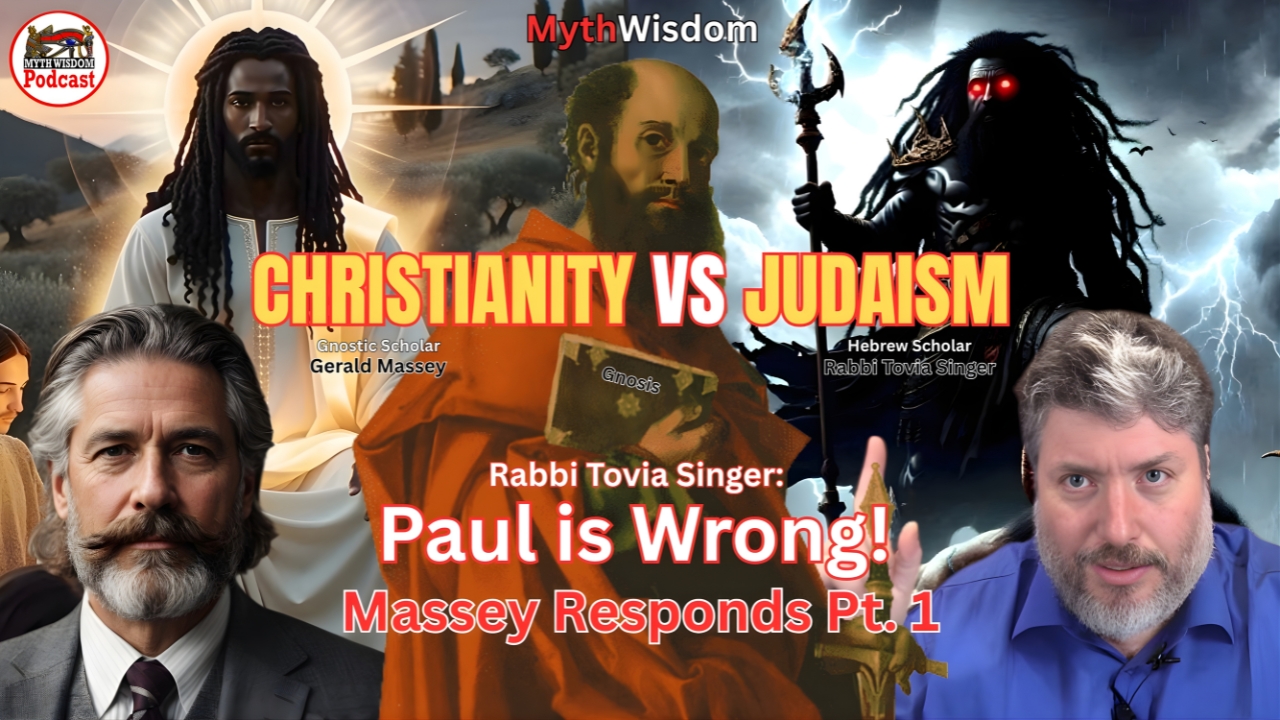
Massey portrays Paul as a “Hebrew Gnostic” and “Apostle of the Heretics” who was an initiate in the ancient mysteries and a fierce opponent of the Jerusalem apostles who were historicizing the mythos.
• The Conflict with the “Pillars”: The feud described in Galatians 2 between Paul and the “pillars” (Peter, James, and John) was not a minor disagreement over circumcision but a profound clash between Gnosis and “Sarcolatry”. Paul’s gospel was “not after man” but derived from revelation (trance-vision), which aligns with the Gnostic insistence on internal mystical experience over external historical testimony.
• Doctrinal Opposition: Paul rejected the “fleshly” resurrection preached by the “men of sin” (the historicizers), teaching instead a conditional immortality through the transformation of the “body of humiliation” into a “spiritual body” (the Egyptian Sahu). His reference to the “Christ in the flesh” whom he no longer knows is a Gnostic dismissal of the carnalized Messiah in favor of the spiritual Logos.
• Interpolation and Historicity: Massey contends that the Pauline epistles were worked over by later “Sarkolaters” in Rome to insert historicizing touches. For instance, the opening of Romans (1:3), which claims Jesus was of the “seed of David according to the flesh,” is a late addition designed to tether the Gnostic Paul to a human genealogy. Similarly, shifts in 1 Corinthians 15 reveal a struggle between the Gnostic doctrine of the “incorporeal spirit” and the “orthodox” demand for a physical rising.
• Paul as a Collective Voice: Given these contradictions and the century-long concealment of his writings, Massey treats “Paul” as a possible school of Gnostic thought rather than a singular biographical individual. Paul functions as the “alibi” for the Gnostics; his silence on the miracles and biography of the “historic Jesus” serves as evidence that his Christ was the A W (Alpha and Omega) of the astronomical mythos, not a Judean peasant.
V. Synthesis and Implications
In this framework, the transition from Egyptian religion to Christianity was accomplished through the “Discipline of the Secret,” where the ancient astronomical and eschatological truths were “petrified” into a literal history for the “simple-minded”. The Gnostics were the final heirs of the Nilotic Gnosis who recognized that the “Jesus” of the Gospels was a “Marionette Messiah” built from the cast-off clothing of Horus and Iu-em-hetep. By reclaiming the “Ancient Model” and restoring the Egyptian “Sign-Language,” we discover that the Christian faith is not a new beginning but the “waning light of ancient knowledge” mistaken for a new dawn.



Leave a Reply