


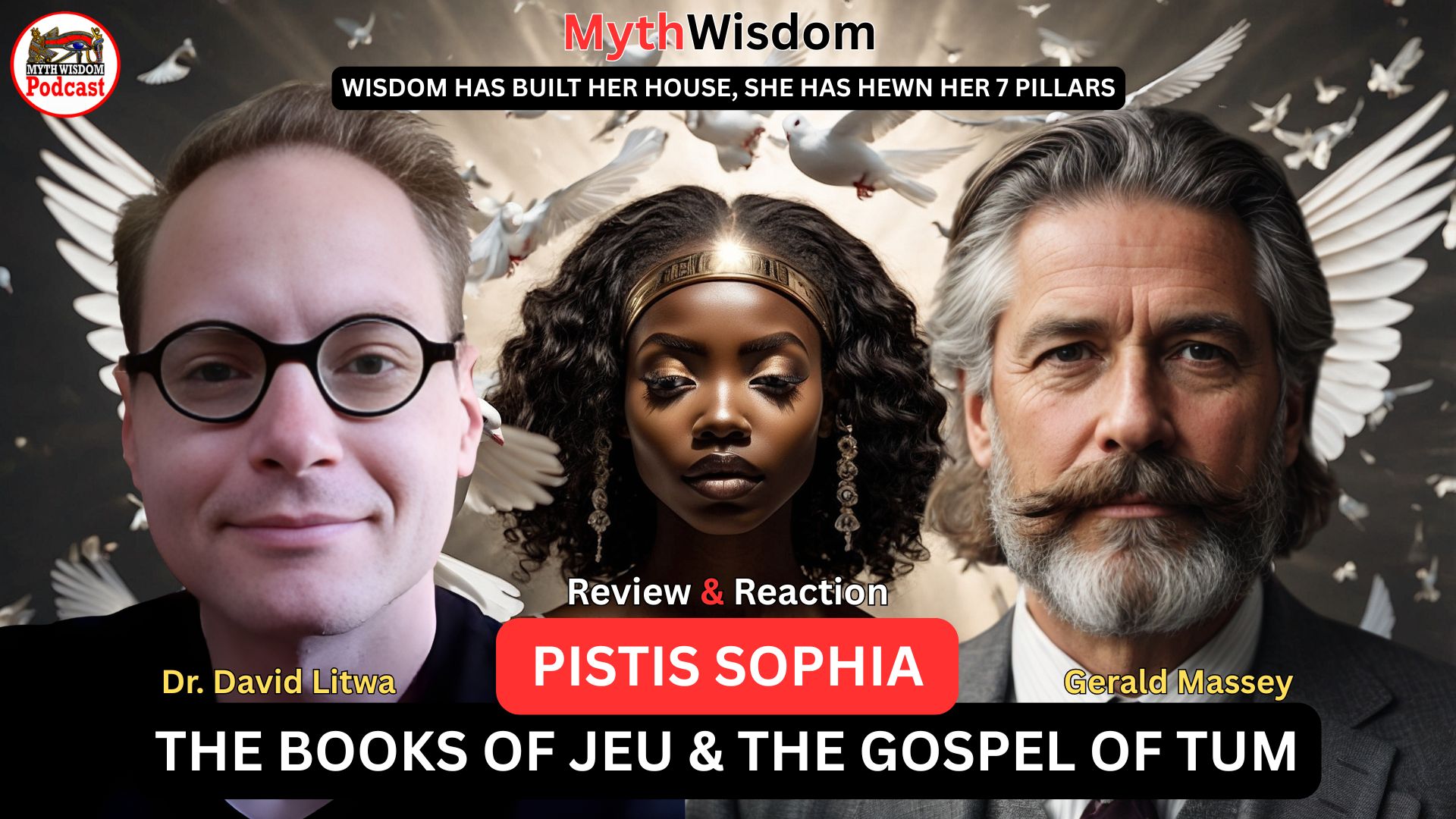

Introduction: Framing MacDonald with Massey and Bernal
In analyzing the contentions of Dr. M. David Litwa regarding the Gospel of Thomas, Pistis Sophia, and the nature of Gnosticism, a profound divergence emerges when applying the criteria of Gerald Massey and Martin Bernal. While Litwa approaches these texts from the perspective of second-to-third-century Egyptian Christianity, Massey and Bernal view them as the surviving “debris” of a ten-thousand-year-old Kamite (Egyptian) astronomical and eschatological system.
I. The Origin and Dating of the Gospel of Thomas
Litwa contends that the Gospel of Thomas is a mid-second-century Egyptian text designed to present a “Gnostic path” through familiar synoptic-style sayings. He notes that scholars have historically avoided calling it “Gnostic” to prevent it from being viewed as marginal.
Response: From the Masseyan perspective, the dating of the “Thomas” traditions to the second century is a primary error of the “Sarkolatræ” or carnalizers of the mythos. Massey argues that the Gospel of Thomas is fundamentally the “Gospel according to Tum” (Atum-Ra), the Egyptian god of the sunset and father of the son Iu-em-hetep. The name “Thomas called Didymus” (the Twin) is a literalized version of the Egyptian Tum, who possessed a twin-totality in his characters of father and son. Furthermore, Bernal points out that Greek religious terms such as sophia (wisdom) are not late Hellenistic inventions but are derived from Egyptian roots like sbȝ (teaching/learning), meaning the “Gnostic” content Litwa identifies in the second century actually reflects a much deeper Afroasiatic strata.
II. Exclusivism vs. Internal Light: Thomas and John
Litwa argues that the Gospel of Thomas serves as a response to the exclusivism of the Gospel of John; where John claims Jesus is the “only way,” Thomas claims every human is the “only way” by discovering the internal light.
Response: Massey asserts that both the Johannine and Thomasine traditions are based on the same Egyptian Ritual. The “Word” (Logos) in John is the Egyptian Kheru or the child-Horus who issued from silence. Litwa’s observation that Jesus remains a “talking head” and never truly becomes “flesh” in Thomas aligns with Massey’s claim that the original Gnostic Christ was never a historical personage but an “ideal figure of a fact known to ancient spiritualists”. Massey would refute Litwa’s “crazy theory” of literary response by stating that these were not authors competing in the second century but compilers of the “Logia Kuriaka” (Sayings of the Lord), which were the words of Mati (the Egyptian scribe Taht-Aan/John) collected from the Ritual of the Resurrection.
III. The Role of James (Saying 12)
Litwa suggests that Saying 12, which claims heaven and earth were made for James the Just, is “satire” because the world is viewed negatively in Thomas as a “carcass”.
Response: In the Egyptian mythos, the companions of the Lord were not satirical figures but astronomical representations. Massey identifies the “twelve” as the rowers of the solar bark for Ra, and the “four” (including James and John) as the four genii of the corners who stand upon the papyrus-column. The statement that the world was made for James reflects the Egyptian doctrine where the “heir of the temple” or the “active one of Heliopolis” (Horus/Iu) is established by the father to rule over the double earth of Seb. Thus, Saying 12 is not satire but a remnant of the “investiture of the garden” where the righteous manes (personified by James/Jacob) takes possession of the wealth assigned to him in the earth of eternity.
IV. Pistis Sophia and the “Degeneracy” of Later Gnosticism
Litwa discusses the scholarly neglect of Pistis Sophia and the “Books of Jeu,” noting that some scholars view them as “degenerate” forms of Gnosticism due to their intense focus on complex metaphysics and magical formulas.
Response: Massey vehemently rejects the label of “degeneracy” for these texts. He maintains that Pistis Sophia is a vital link because it preserves the Egyptian names and dualities of God the Father (Huhi/Ieou/Ihuh) and God the Son (Iu/Iao/Iah). The “magical names” and “passwords” Litwa finds strange are actually the Hekau or words of power found in the Book of the Dead, which were necessary for the soul to navigate the twelve dungeons or divisions of Amenta. Bernal would add that the “orientalist” bias Litwa notes in scholarship is part of the “Aryan Model” that sought to detach Greek and Gnostic philosophy from its Egyptian and Phoenician roots.
V. The Transfiguration and the Mount of Olives
Litwa describes the Pistis Sophia as beginning with Jesus rising from the dead and teaching his disciples on the Mount of Olives for eleven (or twelve) years.
Response: Massey identifies the “Mount of Olives” in Pistis Sophia and the Gospels as Mount Bakhu, the Egyptian “Mount of the Olive Tree” of the dawn, which was the way of ascent for the risen Savior issuing from Amenta. The “eleven years” (or twelve) spent by Jesus on earth before his ascension is a literalization of the twelve years of child-life for Horus the Elder, who wore the sidelock of infancy until his transformation at age twelve into the adult Horus/Jesus of thirty years.
VI. The “Twofold Philosophy”
Litwa emphasizes that Gnosticism was an “exoteric text” for a “new vision of Jesus”. He views the system as a creative synthesis or “syncritism”.
Response: Bernal argues that what modern scholars call “syncritism” was actually the “Ancient Model” of cultural diffusion. The “twofold philosophy” Litwa mentions (superstition for the masses, gnosis for the elite) is the exact structure of the Egyptian priesthood, where the Her-Seshta (teachers of mysteries) kept the biological and astronomical truths of nature concealed behind zootypical allegories. Massey concludes that the “Gnostic” Christ remained an “ideographic type” of the spirit, whereas the later Church’s failure was in mistaking the mystery-drama for mundane history.



Leave a Reply