


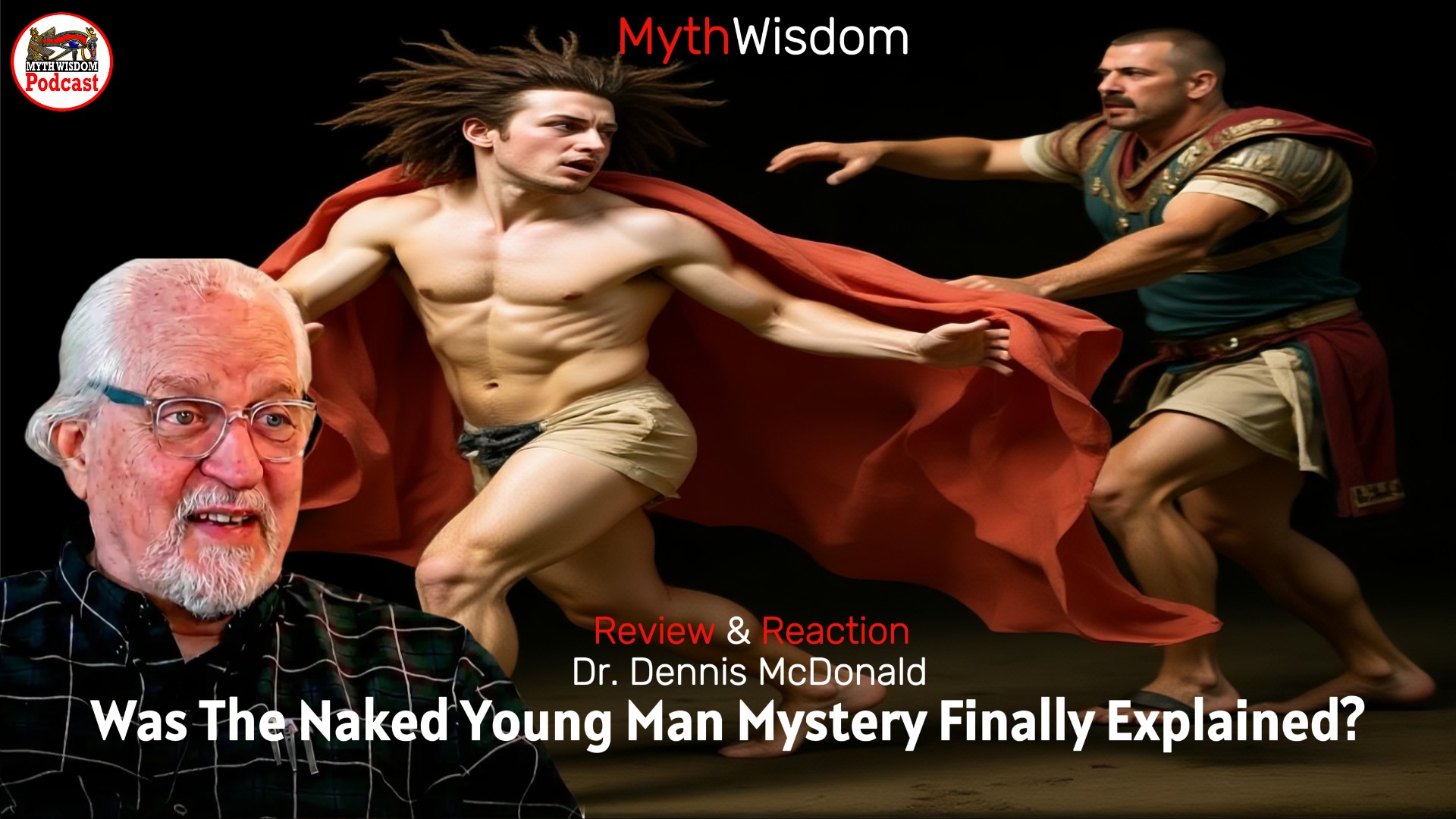

The episode of the “fleeing naked young man” (neaniskos) in Mark 14:51–52 and its structural reappearance in Mark 16:5 represents a critical intersection of literary mimesis and ancient mythographic typology. Analyzing Dennis MacDonald’s interpretation through the lens of Gerald Massey’s Egyptian-Christian parallels reveals a transition from the astronomical mythos of Egypt to the Greco-Roman literary strategies of the first century.
I. MacDonald’s Thesis: Literary Mimesis and the Homeric Model
The Neaniskos as Literary Creation MacDonald contends that the young man who flees naked from the garden of Gethsemane is not a preserved historical memory or a self-reference to the author (the “Mark himself” hypothesis), but a sophisticated literary creation. MacDonald identifies this figure as a narrative bridge constructed to link the shame of the Passion with the glory of the Resurrection.
Homeric Parallels: The Elpenor Motif Central to MacDonald’s position is the claim that Mark intertextually engages with Homeric characters, specifically Elpenor from the Odyssey. Elpenor, the youngest of Odysseus’ crew, falls from a roof in a drunken stupor, breaking his neck; his soul then “flees” to Hades while his body is left behind. MacDonald notes that in ancient art, Elpenor was frequently depicted as nude. In Mark’s narrative, the youth abandons his sindon (linen cloth) and flees naked, mirroring the separation of soul and body and the flight toward the underworld.
Function in Markan Strategy MacDonald reads this youth as an “anti-hero” whose failure mirrors the broader failure of the disciples. The youth’s flight in shame (nakedness) provides a deliberate contrast to his appearance at the empty tomb, where he is “robed” in a white garment (stolē). For MacDonald, this transition from the nakedness of Gethsemane to the white robe of the tomb symbolizes the transformation of a baptismal initiate or a witness to the resurrection.
II. Comparative and Symbolic Dimensions
Clothing as Symbolism MacDonald emphasizes the word sindon (linen cloth), noting it is the same term used for the shroud in which Joseph of Arimathea wraps Jesus. The abandonment of this cloth in the garden signifies the inability of the disciples to follow Jesus into death. Conversely, the “white robe” at the tomb represents the “post-baptismal robe” of a candidate who has “died and risen with Jesus”.
Contrast with Traditional Scholarship MacDonald’s view is distinct from other scholarly explanations:
• Historical Reminiscence: Rejects the idea of an anonymous witness or the author Mark.
• Baptismal Symbolism: While MacDonald acknowledges that early Christians likely saw a “male baptismal candidate” in the scene, he maintains that the underlying structure is an imitation of the Homeric trope.
• Secret Gospel of Mark: Secondary literature often connects this youth to the “Secret Gospel” tradition, involving initiatory rites. MacDonald, while cautious, recognizes the youth as a “mysterious” figure that fits the broader context of ancient mystery patterns.
III. Integration of Massey’s Egyptological Framework
The Egyptian Origin of the Sindon Gerald Massey identifies the sindon (Greek) as the Egyptian shenti, the linen garment of the mummy made from shena (flax). To Massey, the “young man” in the garden is not a literary trope from Greece, but a “form of the manes [spirit] risen with the bandages about him”. Massey argues that when the youth “left the linen-cloth and fled naked,” he was dramatically enacting the transformation from a physical mummy (Osiris) to a spirit (sahu).
Horus-Jesus Parallels in Gethsemane Massey traces the scene in Gethsemane to the Egyptian “Pa” or “Am-Smen,” where Horus suffered his “agony and bloody sweat” when wounded by the black boar, Sut. In the Ritual (Book of the Dead), this scene involves the “night of the battle,” where the “undrowsy watchers” in Annu are turned into the “drowsy watchers” of the Gospel garden.
The Two Witnesses Where MacDonald sees Homeric mimesis, Massey sees the “Two Witnesses” of the Egyptian judgment scenes: Anup (the baptizer) and Aan (the divine scribe/John). Massey links the youth to the character of the “Only-begotten from the Father” (Horus in spirit), who must “disrobe” to reveal himself to the earth.
IV. Critical Evaluation and Synthesis
Strengths and Weaknesses of the Mimesis Proposal MacDonald’s reading excels in explaining the internal narrative logic of Mark, specifically the pairing of the youth in the garden and the tomb. The Homeric parallels provide a culturally accessible model for a first-century audience trained in Greco-Roman epics. However, the proposal can be seen as “tone-deaf” to the deeper funerary and baptismal roots of the imagery, as Massey argues.
Massey’s Mythic Patterning Massey’s framework reinforcement:
• Narrative Pair: The garden youth and tomb youth represent the two halves of a soul established in the “mystery of Tattu”—the mortal Horus and the immortal spirit.
• Resurrection Typology: The “white robe” at the tomb is the Egyptian “vesture of truth” or “pure garment” given to the manes after passing the judgment-hall.
Reasoned Judgment The “fleeing naked young man” is best understood as a symbolic construct that functions at two levels. At the literary level, MacDonald is likely correct that Mark employs Homeric mimesis to reach his audience and illustrate discipleship failure. However, at the typological level, Massey proves that the specific elements—the linen cloth (shenti), the garden struggle (Pa), and the transformation into a “white-robed” spirit—derive from the Egyptian Osirian drama. The youth is a “manes” figure serving as a visual representation of the soul’s survival and transformation.
V. Methodological and Historiographical Reflection
Mimesis vs. Mythography
• MacDonald’s Method: Modern intertextual/Homeric-mimesis assumes the author intentionally remodeled a secular epic into a sacred one.
• Massey’s Method: Late-19th-century mythography posits that the Gospel is a literalized, “carnalized” version of an ancient astronomical and eschatological system.
Impact on Historicity Both approaches impact questions of historicity by demonstrating that the episode is non-historical. MacDonald views it as “symbolic fiction”; Massey views it as “refracted mythology” that has been “turned into history” by those who lost the original Gnosis.
Criteria for Parallels In weighing these parallels, one must employ the criteria of verbal density (the shared use of sindon) and sequence (the pattern of betrayal, burial, and transformation). While MacDonald’s Greco-Roman context is historically immediate, Massey’s Egyptian comparanda provide the necessary “rootage” for the clothing metaphors and resurrection typology, demonstrating that Mark’s “literary creation” utilized a pre-existing mythic vocabulary of the soul



Leave a Reply