


By MythWisdom
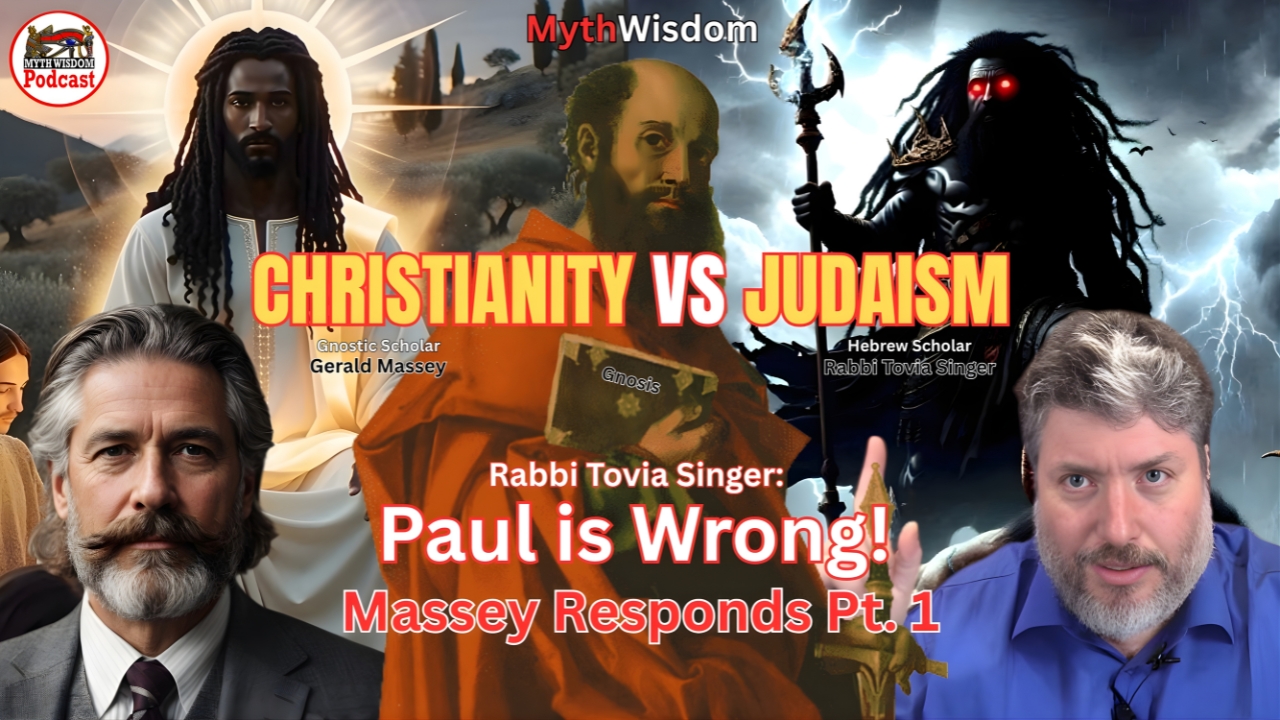
The origin of the God of Israel, identified variously as Ihuh (Jehovah), Jah (Iah), and El Shaddai, can be rigorously analyzed through the Egyptocentric diffusionism of Gerald Massey and the Afro-Asiatic model of Martin Bernal, both of whom locate the primal source of Mediterranean religious symbols in the Nile Valley and the broader African substrate. Within this theoretical framework, the God of Israel is not viewed as a unique historical revelation but as a transition of Egyptian and African mythological types into a Semitic ethno-religious identity.
I. Genealogies of Myth and Motif: Sabean and Typhonian Foundations
According to the Egyptocentric thesis, the primary origin of the deity Jehovah-Elohim lies in the most ancient Egyptian “Sabean” mythology, specifically centered on the Great Mother and her seven elemental children. Massey asserts that Jehovah is a modified form of the Typhonian genitrix, Kefa or Khebt, the goddess of the Great Bear (seven stars), who personified the birthplace of the beginning in the celestial north. The term Elohim is identifies the “Seven Great Spirits” or Ali who were the primordial companions of this genitrix, later continued as the seven spirits of God in various traditions.
The male character of the God of Israel developed from the sonship of this genitrix, originally represented by Sut (or Seth/Sutekh), the deity of the Dog-star (Sirius). This “son of the woman” was the earliest male manifester of the deity, a “Coming One” who preceded the establishment of the divine fatherhood. Martin Bernal supports this by identifying the Israelite Yahweh as a counterpart to the Egyptian god Seth, the divinity of the wilderness and the sea. Consequently, the earliest God of Israel was a Typhonian or Sabean deity, an “unclean” outcast from the perspective of later solar-oriented Egyptian dynasties.
II. Comparative Mythology and Typology: The Solar and Luni-Solar Transformation
The transformation of the God of Israel from a Sabean child of the mother into a “One God” fatherhood corresponds to the transition from the cult of the mother/son (Aten/Adon) to the solar fatherhood personified by Atum-Ra at On (Heliopolis). In this stage, the Egyptian Atum becomes the prototype for the Hebrew Adam and the patriarch Abraham, shifting the divine likeness from the feminine and the zootype to the perfect man.
This “New Creation” established the deity as a “God by himself,” a solar sovereign who absorbed the powers of the earlier seven spirits. Massey identifies the “One God” Ihuh with the Egyptian title Huhi (The Eternal), a designation applied to Atum-Ra and Osiris to signify self-existence through cycles of time. This deity was represented as a biune being, containing both male and female natures—the “Male-Mother”—which is reflected in the Kabbalistic and Gnostic interpretations of the divine name.
III. Historiography and Ideology: From the Shasu to Monotheism
Modern scholarship, as summarized by Dan McClellan, provides a different historical trajectory, suggesting that the patron deity of Israel shifted from the patriarchal high deity El (as seen in the name Isra-el) to Yahweh between c. 1208 BCE and 850 BCE. This model proposes that a group of Shasu nomads from the land of YHW migrated into the central Hill Country, bringing their patron god and conflating him with the Northwest Semitic storm god Baal before his final merger with El.
Massey, however, argues that these “Shasu” or “Aamu” were already Typhonian worshippers within Egypt, identifiable as the “mixed multitude” of outcasts and lepers (Aati) who were driven forth during various religious expulsions. He contends that the “Exodus” was a mythological representation of the sun (or souls) coming out of the “Lower Egypt” of the netherworld (Amenta), which was later literalized as a historical migration of a Semitic ethnic entity. In this view, the God of Israel’s “territory” was primarily astronomical before it was geographical.
IV. Textual and Philological Evidence: The Divine Names
The philological roots of the God of Israel are consistently traced to Egyptian terms representing time and existence:
• Ihuh (Jehovah): Derived from Huhi (the Eternal), the one who always had been, is, and shall be.
• Jah (Iah): Derived from the Egyptian Iu (to come/duplicate), signifying the “Coming Son” or the ever-recurring manifestor of the father.
• Adonai: Corresponds to the Egyptian Aten or Adon, the lord of the solar disk, whose cult at On provided the basis for the later Semitic Adonai.
• El Shaddai: Traced to Shadai (the suckler), an epithet for the teated genitrix, often represented by the sow (Shat) or the hippopotamus, illustrating the deity’s origin in the motherhood.
V. Synthetic Judgment
The God of Israel emerged as an adaptation of the oldest Egyptian mythological systems, specifically those of the “first time” involving the Great Bear and the Dog-star. This deity transitioned from a Sabean-Typhonian son of the mother to a solar father through the theology developed at Heliopolis (On). While conventional history seeks the origin of Yahweh in the desert of the Midianites or the land of the Shasu, the deeper theoretical framework of Massey and Bernal suggests that these groups were the vehicles for a much older African and Nilotic wisdom that was “falsely founded” as human history in the Hebrew and Christian scriptures. Ultimately, the God of Israel is a continuation of the Egyptian Iu (the Jew-God), a wanderer of eternity representing the eternal life attained through transformation in the netherworld.



Leave a Reply