


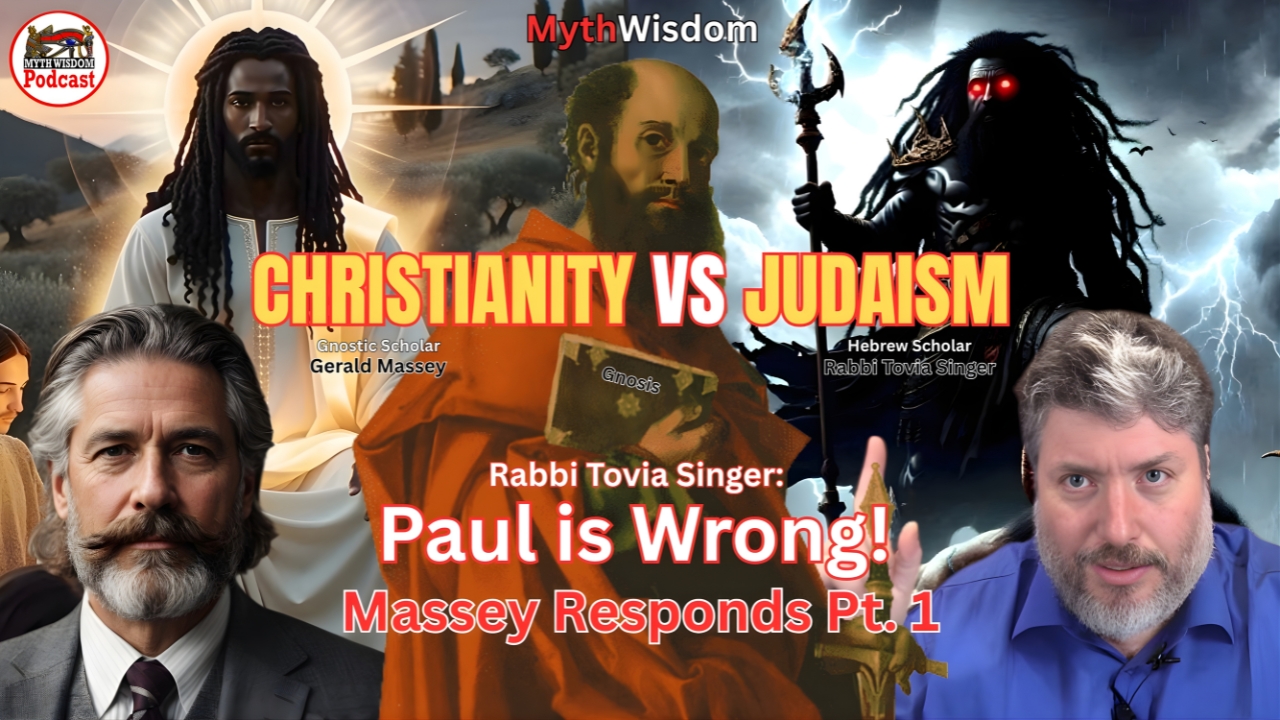
In his video “Responding to a bad argument for mythicism,” Dan McClellan presents a critique of the parallels between the Egyptian Horus-mythos and the Christian Jesus-narrative, categorizing the connections as “made up,” “outdated,” or based on a misunderstanding of historical development [ts:229, 806, 1096]. However, when examined through the exhaustive six-volume corpus of Gerald Massey—A Book of the Beginnings (BB), The Natural Genesis (NG), and Ancient Egypt: The Light of the World (AE)—it becomes clear that McClellan’s position rests upon a “Sarkolatræ” (flesh-worshipping) framework that ignores the evolutionary mythography of the Nile Valley.
Massey’s methodology demonstrates that the “historical Jesus” is a carnalized mask for the Egypto-Gnostic Iu-su (the ever-coming son), whose attributes were formulated over ten thousand years of astronomical observation and eschatological development.
——————————————————————————–
I. Verbatim Claims and Point-by-Point Counter-Analysis
McClellan Claim 1: Parallels are “Made Up” [ts:806-834]
McClellan asserts that lists of parallels (e.g., Horus born of a virgin, 12 disciples, baptism at 30) are largely fabricated by modern internet atheists and have no basis in primary Egyptian texts.
Massey’s Refutation: The parallels are not “made up” but are the “debris of the astronomical mythology” preserved in the Ritual (Book of the Dead) and temple inscriptions.
• The Virgin Birth: McClellan argues Horus was conceived via post-mortem intercourse between Isis and Osiris. Massey clarifies that the mythical birth is twofold: Horus is the child of the Virgin (Isis/Neith) who “proceeded from herself”. In the cult of Atum-Ra, the mother is Iusāas, who was “great with Iusa” (the Egyptian Jesus). The annunciation and conception were engraved at the Temple of Luxor 1,700 years before the Christian era.
• The 12 Disciples: McClellan claims there is no list of twelve disciples for Horus. Massey identifies the “Twelve” as the reapers in the harvest-fields of Amenta (the netherworld) and the twelve who row the solar bark for Ra. These twelve are the “just ones” who assist Horus-Khuti in the fields of divine harvest, a direct prototype for the 12 apostles who “reap the harvest” in the Gospels.
• Baptism at Thirty: McClellan dismisses the link between the baptism of Jesus and Horus. Massey provides the primary evidence: Horus makes his transformation from the child of twelve years (mortal) to the adult of thirty years (spirit) in his baptism by Anup (Anubis). This transition into “Khem-Horus” (the typical adult of thirty) is the only reason the Gospel-Jesus has no history between twelve and thirty.
McClellan Claim 2: No Pre-NT “Crucified God” [ts:494-502]
McClellan argues that crucifixion was a specific Roman punishment and that no deity was “crucified” prior to the New Testament.
Massey’s Refutation: McClellan’s literalism fails to account for the “Mystery of the Cross” (the Tat). The Tat-pillar was a figure of the fourfold foundation on which the universe was built.
• The Osiris-Tat: In the mysteries of Amenta, Osiris was the “mummy-god” extended or standing with arms akimbo in the Tat-cross. This “Lord who was crucified in Egypt” (echoing Revelation 11:8) represented the god in matter awaiting the resurrection in spirit.
• The Piercing: McClellan denies a pierced deity. Massey cites the Ritual (Ch. 112), where Horus is wounded and “pierced to the heart by Sut” (Satan) in his suffering state. This suffering “afflicted one” (An-maati) is the prototype for the “man of sorrows” who is “wounded for our transgressions” in Isaiah and the Gospels.
McClellan Claim 3: Legends Post-Date the Historical Jesus [ts:229-245]
McClellan maintains that any similarities are late “accretions” that were added to the memory of a real man after his death.
Massey’s Refutation: Massey uses the “Law of Precession” to prove the antiquity of the mythos. The Iu-em-hetep (Egyptian Jesus) was one of the “eight great gods” of Egypt extant twenty thousand years ago (Herodotus 2:43).
• The Pre-eval Basis: The “Jesus-Legend” was humanly applied to Amen-hetep III 1,700 years B.C.. The “historical” version is merely the “mystical drama made mundane” by the idiotai who lost the Gnosis.
• Chronological Proof: Massey argues that the Gospel narrative follows the shift of the vernal equinox from the sign of the Ram (Lamb) to the Fishes (Ichthys). This transition occurred around 255 B.C., a date which marks the scientific beginning of the “Christian” era in heaven before it was literalized on earth.
McClellan Claim 4: “Dying-Rising Gods” are Outdated [ts:1096-1102]
McClellan dismisses the “dying-rising god” category as a defunct 19th-century academic construct (e.g., Frazer).
Massey’s Refutation: Massey’s “dying-rising” deity is not a caricature but a precise “transformation” (Kheper). Osiris does not “die” in the modern sense; he is “inert” and “motionless” in the mummy-form (Karast) to be “raised by Horus”.
• Amsu-Horus: This is the figure of the risen Christ: the mummy that has attained its feet and freed its arm. The “resurrection on the third day” is an astronomical fact of the moon’s renewal, which was applied to the soul in the eschatology



Leave a Reply