


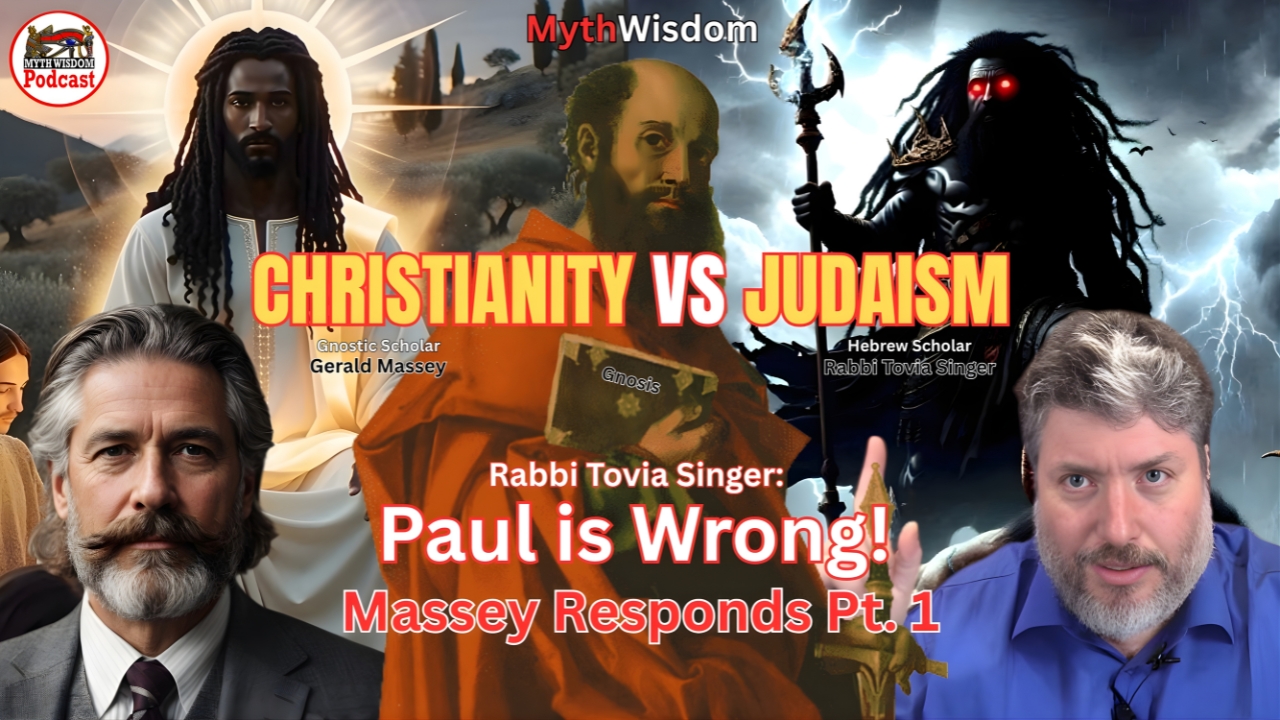
In analyzing Rabbi Tovia Singer’s arguments regarding the alleged errors of the Apostle Paul, one must move beyond the standard theological debate between Rabbinic Judaism and Pauline Christianity. Utilizing the comprehensive frameworks of Gerald Massey, Walter Williams, and Martin Bernal, we find that Singer’s critique relies on a “Sarcolatrae” (flesh-worshipping) literalism that overlooks the profound Egyptian origins of both the Torah and the Pauline Gnosis. From this perspective, the “discontinuity” Singer identifies between the “Jewish Jesus” and “Pauline Christ” is not a historical clash between two men, but the friction caused by literalizing an ancient Afroasiatic mythos into a spurious history.
I. The Nature of the “False Gospel”: Gnosis vs. Literalism
Singer contends that Paul’s gospel is a “false” departure from the original, Torah-observant teachings of Jesus. He asserts that Paul’s rejection of the Law as a path to salvation represents a fundamental misunderstanding of the Sinai covenant.
Massey’s Typological Counter-Analysis: Massey demonstrates that the “Law” (Hebrew Torah) is rooted in the Egyptian Teruu (papyrus rolls of the law) and the concept of Maat (Truth, Law, and Justice). The Sinai covenant is not a historical event in the 13th century BCE but an astronomical and eschatological allegory based on Mount Sheni (the Egyptian mount of the equinox and the circle of turning).
Paul, far from being “wrong,” functioned as a Hebrew Gnostic who understood that the “Law” was a schoolmaster—an elementary stage of the Sabean and Solar mythos—intended to lead to the “spirit” of the mystery. The “False Gospel” Singer describes is actually the result of the Church Fathers literalizing Paul’s Gnostic terminology into a “Word-made-flesh” history, a process Massey calls the “grossest ignorance” of the idiotai.
Williams and Bernal Corroboration: Walter Williams argues that the “historical origin” of Christianity is a political fabrication where African spiritual systems were suppressed and rewritten through a Greco-Roman lens. Singer’s insistence on a historical Jewish teacher (Jesus) as the standard for Paul ignores the likelihood that the “Jesus” figure was a fabrication, potentially modeled on Ptolemy I (Serapis) to gain acceptance within Egyptian priestly society. Martin Bernal reinforces this by showing that the “Greek Miracle” and the subsequent “Western” religious tradition were built upon Afroasiatic foundations that were systematically obscured by the “Aryan Model” of scholarship, which sought to detach the Bible from its African roots.
II. The Concept of the “Messiah”: From Karast to Christ
A central pillar of Singer’s argument is that the Jewish concept of the Messiah is strictly human and non-divine, whereas Paul’s Christ is a pagan-style “dying and rising” god.
Point-by-Point Refutation using Massey’s Typology:
• The Karast Origin: Massey proves that the word “Christ” derives from the Egyptian Karast, the mummified and anointed one. The resurrection of the Christ is not a mid-first-century miracle but a representation of the Egyptian Sahu—the spiritual body emerging from the mummy-case.
• The Suffering Victim: Singer views the “pierced” and “suffering” savior as un-Jewish. Massey identifies the prototype in the Ritual of the Resurrection, where Horus is “pierced to the heart by Sut” (Satan) in the darkness of Amenta.
• Divine Duality: The “Son of God” concept is not a Pauline invention but the Egyptian Iu-su (the ever-coming son), the manifestor for the father Atum-Huhi (the original of the Hebrew Ihuh).
Comparative Table: Egyptian vs. Pauline Motifs
| Motif | Egyptian Source (Massey) | Pauline Adaptation |
|---|---|---|
| The Law | Mati/Maat (The Two Truths) | The Law as Aletheia (Truth) |
| The Christ | Karast (The Anointed Mummy) | The Anointed (Christos) |
| Second Adam | Atum (The first created man) | The Second Adam (Atum) |
| Resurrection | Sahu (The spiritualized body) | The Incorruptible Body |
III. The Discontinuity Between Jesus and Paul
Singer emphasizes the conflict between Paul and the “Jerusalem Church” (James, Peter, and John) to show that Paul hijacked the “real” Jesus.
Massey’s Gnostic Interpretation: Massey identifies this “conflict” as the historical mask for the transition from Gnostic interpretation to literalized “Sarcolatry”. Paul was “epopt and perfect” among those who knew that the “history” was a delusion. His “mystery of lawlessness” was likely aimed at those who were turning the mythic Iu-su into a historical man. Singer’s “Jesus” is a phantom of history, while Massey identifies the real source as the Egypto-Gnostic Jesus who taught in Amenta (the spirit world), not on the physical earth.
Secondary Support from Bernal and Williams: Bernal’s “Ancient Model” confirms that the Greek-speaking world (in which Paul operated) was thoroughly permeated by Egyptian mystery cults long before the first century. Terms like Sophia (Wisdom), used by Paul, are not late Hellenistic concepts but are derived from Egyptian roots like sbȝ (teaching/wisdom/star). Walter Williams adds that the suppression of these “Coptic Egyptian roots” created a Eurocentric worldview that Singer ironically relies upon when he tries to ground the debate in a specific, localized “historical” context.
IV. Conclusion: Refuting the Premise of “Wrongness”
Rabbi Singer’s position that Paul was “wrong” is only valid if one accepts the 19th-century “Aryan Model” of history, which assumes Judaism and Christianity are unique, isolated, and historical developments. However, Massey demonstrates that the entire structure—from the “Fall in Heaven” (an Egyptian mythos) to the “Exodus” (a celestial transit)—is the “debris of the astronomical mythology”.
Paul was not “wrong” about the Torah; he was attempting to preserve the Gnosis of its origins against those who were “petrifying” the symbols into a dead history. By identifying the Karast as the original Christ and Maat as the original Law, Massey, Williams, and Bernal provide a comprehensive refutation of Singer’s polemic, showing that both the Rabbi and the Apostle are engaging with the “petrified remains” of a much older Nile Valley wisdom



Leave a Reply