


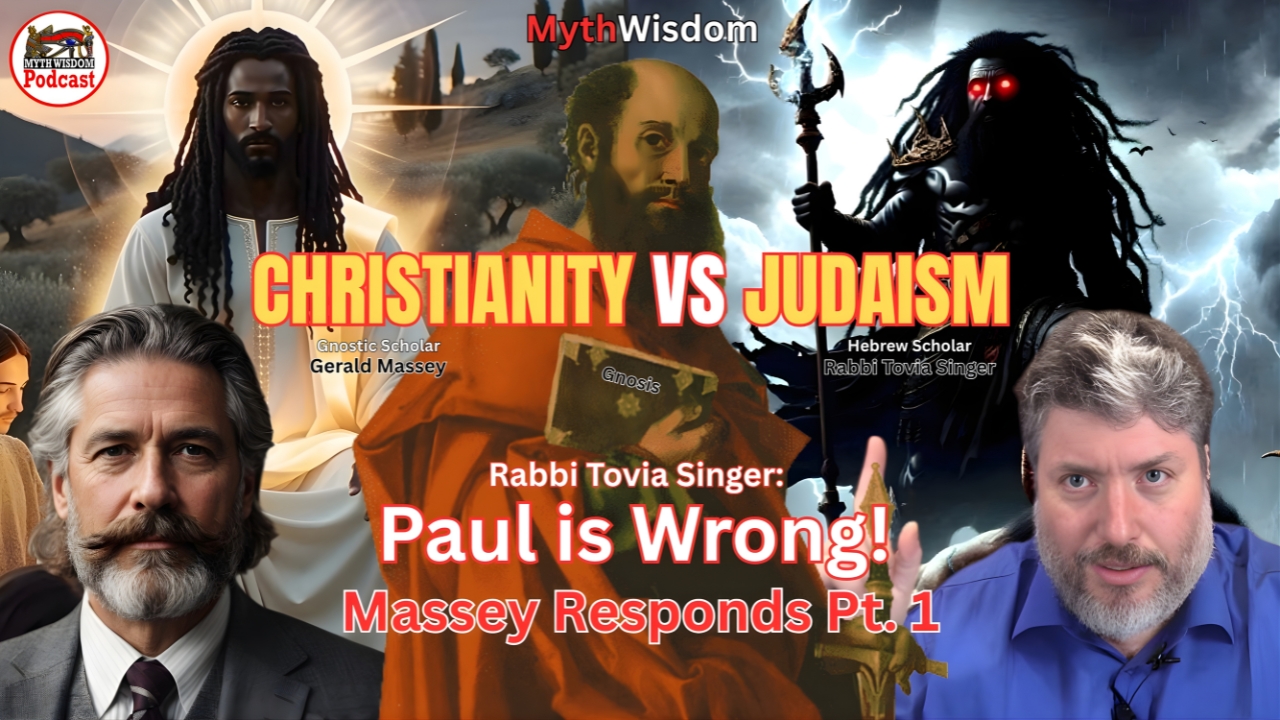
The following critique deconstructs Rabbi Tovia Singer’s assertions in the video “Daniel’s Messiah is NOT Jesus” by applying the mythographic and astronomical framework of Gerald Massey, with selective support from Bernal and Williams. Singer’s arguments are rooted in a “Sarkolatræ” (flesh-worshipping) literalism that treats the Hebrew text as a self-contained ethnic history. In contrast, Massey demonstrates that the book of Daniel, specifically the “70 weeks” and the “cut-off” Messiah, represents the debris of an ancient Egyptian astronomical system that predates Rabbinic Judaism by millennia.
I. The Etymological Origin of Mashiach (Messiah)
Singer’s Assertion: The word mashiach simply means “anointed” and is used historically for priests and kings, never as a title for a unique, divine “Messiah”.
Massey’s Dissection: Singer’s analysis stops at the surface of the Hebrew language, failing to recognize the “Nile Valley civilization” as the “birthplace of articulate man” and religious typology.
• The Karast Prototype: The term “Christ” or “Messiah” is derived from the Egyptian Karast (or Krust), meaning the embalmed, anointed, and “incorporate” mummy. To karas a body was to make it a “type of immortality”.
• The Mesu: The Hebrew Messiah finds its root in the Egyptian Mes (birth, rebirth) and Mesu (the anointed, the child). The Messiah was originally the ever-coming child of the inundation (Iu-su), a periodic manifestor in nature, not an individual historical person.
• Refutation of Sacerdotal Use: While Singer claims mashiach refers to the Aaronic priesthood, Massey shows that the “anointed one” was first “the adult youth who has attained the rank of begetter” at the time of the totemic puberty mysteries, a rite later spiritualized into the “Son of the Father” in Egyptian eschatology.
II. The Chronology of the “70 Weeks”
Singer’s Assertion: Daniel 9 is a precise historical timeline of 490 years (70 weeks), concluding with the destruction of the Second Temple and the “cutting off” of the priesthood.
Massey’s Dissection: Singer mistakes a “celestial allegory” for “mundane history”. The numbers in Daniel are “Kronian” or astronomical, relating to the cycle of precession.
• Precessional Cycles: The “seventy weeks” are not linear years but symbolize the “seventy divisions” of the earlier heaven that preceded the seventy-two duo-decans of the solar zodiac.
• The Ending of an Æon: Daniel 9:26 predicts that the end shall be “with a flood.” Massey explains that in the astronomical mythos, the “deluge” represents the end of an astronomical period or cycle of time, not a historical catastrophe.
• The “One Week” of Silence: The “one week” (seven days) of the covenant in Daniel matches the “old silence of seven days” in the Book of Esdras and the “silence of seven days” marking the former judgments (deluges) in Egyptian myth. These represent the transition between precessional stations, not the timeline of the Roman-Jewish war.
III. Cyrus as the “Messiah”
Singer’s Assertion: Cyrus is the first mashiach mentioned in Daniel 9 because Isaiah 45:1 explicitly names him as God’s anointed.
Massey’s Dissection: Singer’s use of Cyrus to debunk Jesus relies on a failure to understand the “Type.”
• The Repa as Mask: Both Cyrus and the Jesus-figure serve as “masks” for the Egyptian Repa—the divine heir-apparent who represents the “ever-coming one” (Iu) in the sphere of time.
• Solar Manifestation: Cyrus is identified as a “Messiah” because he, like Alexander and Augustus, was invested with the attributes of the solar manifestor of a new cycle. This does not validate a historical reading but proves that “historic personality” was merely “the vesture of divinity” assumed by various rulers.
IV. The “Cutting Off” of the Anointed One
Singer’s Assertion: The “cutting off” (karas) in Daniel 9:26 refers to the removal of the priesthood or a specific execution, which Singer connects to the temple destruction in 70 AD.
Massey’s Dissection: Singer’s interpretation of karase (removed/cut off) misses the primary mythological meaning.
• The Wounded Sun: The “cutting off” is the mythic slaughter of the “Good Being” (Osiris) or the “wounding” of the solar child by the powers of darkness (Sut).
• The Sacrifice Type: In the Ritual, the Kheru (Word) is also the “victim doomed to be sacrificed” on the night of “laying provisions on the altar”. The “cutting off” corresponds to the sun entering the winter solstice or the “dark side” of the moon’s wane.
• Priesthood as Symbol: Singer identifies the priesthood as his “great-great-grandfather”, but Massey traces the priesthood back to the Hir-Seshta (Mystery Teachers) who explained the “endless reckonings” of the stars, not the biological lineage of Aaron.
V. The Falsification of the “New New Beginning”
Singer’s Assertion: Christian translators corrupted the text (capitalizing “Messiah,” adding articles) to fabricate a prophecy of Jesus.
Massey’s Dissection: While Singer correctly identifies translation chicanery, he fails to realize that Rabbinic Judaism is equally built on a “perversion of the ancient wisdom”.
• Shared Plagiarism: The Hebrew writers “mutilated and misrendered” the Egyptian eschatology, turning the “earth of eternity” (Amenta) into the “earth of time”.
• The True Messiah: The “Jesus” whom Singer rejects is the Iu-su of the gnostics, who was 10,000 years old when the alleged historical era began. Paul, the “Apostle of the Heretics,” was a gnostic who knew the “history” was a delusion and taught the “spiritual rock” instead of the “Christ according to the flesh”.
Conclusion
Rabbi Singer’s critique of the Pauline/Christian misreading of Daniel is a valid rejection of the “Aryan Model” of theology but remains trapped within its own “Judeocentric” literalism. Gerald Massey’s evidence proves that Daniel’s Messiah is neither the historical Jesus nor a historical priest of the first century, but the Kronian Christ—the periodic manifestor of the “World’s Great Year”. By identifying the Karast as the original Anointed and the “weeks” as precessional measures, Massey demonstrates that both the Rabbi and the Pastor are pursuing “shadows on the earth” while the reality remains “of heavenly birth” in the Nile Valley



Leave a Reply